PIAB vacuum conveying systems utilise advanced Swedish engineering to provide highly efficient, modular and low-maintenance solutions for a range of material handling applications.


PIAB vacuum conveying systems utilise advanced Swedish engineering to provide highly efficient, modular and low-maintenance solutions for a range of material handling applications.
Pneuvay is proudly an official distributor for PIAB in Australia and is authorised to supply, install, and support its world-class range of vacuum conveyors to local industry. These Swedish systems provide a superior alternative to mechanical conveying by offering a compact, fully enclosed and highly efficient material transfer solution.
PIAB vacuum conveying systems for Australia
Our technical engineers primarily consider factors such as the overall horizontal and vertical transfer distance, in metres, at the required throughput rate in tonnes per hour when designing a solution for a specific type of material to be transferred. If the application falls within the tolerances of these primary factors, further evaluation of the bulk density, particle size and several other key characteristics of the material being transferred is required to select the correct vacuum conveyor model and material transport pipeline routing design.
The primary performance factors for PIAB vacuum conveyors are transfer distance and throughput capacity. These systems can transport material up to:
If the application falls within the required distance and throughput range, our technical engineers apply their expertise in material behaviour and pipeline routing geometry to achieve the optimal system design.
The materials suitable for transfer by PIAB vacuum conveying systems include:
PIAB vacuum conveying systems handle hard materials such as toner, fumed silica, tablets and confectionery, as well as sensitive products including coffee beans, cereal, seeds, nuts and pasta without damaging product integrity. The systems are also effective for abrasive materials such as sand, glass and bronze powder, as well as challenging bridging powders including cocoa, cheese powder, titanium dioxide, milk powder and starch.
Pipeline routing for PIAB vacuum conveying systems offers a high degree of flexibility and an optimal design is developed by our technical engineers for each suitable application. The number of bends and vertical rises are carefully considered to ensure consistent inline material speeds are maintained while also ensuring the pipeline route is best fitted to the surrounding production environment.
The following table summarises these material and pipeline routing parameters across key manufacturing sectors where PIAB vacuum conveying systems can be applied.
| Industry sector | Material types | Material properties | Transfer distances |
|---|---|---|---|
| Food industry | Baking goods Flour Sugar Coffee beans Spices Starches Nuts Tea leaves | Variable | Up to 50 m line lengths depending on density |
| Chemical processing | Abrasive and heavy powders Fine and volatile dusts Fragile and sensitive granules Sticky bridging materials | Variable particle sizes from 0.5 micron | Custom lengths calculated per line configuration |
| Pharmaceutical | Active pharmaceutical ingredients (APIs) Dry minerals Fragile tablets Softgels Capsules | Variable high-purity pharmaceutical mixes | Up to 10 m certified conveying lengths at peak throughputs |
| Metal additive manufacturing | Tungsten carbide Stainless steel Inconel Copper alloys Titanium Aluminium | Ultra-heavy ranges from 1.5 kg/L up to 8.0 kg/L (Al to WC) | Up to 50 m horizontal and 8 m vertical transport boundaries |
| Battery manufacturing | Cathode minerals (Lithium Carbonate, NCA, NMC) Anode materials (Natural/Synthetic Graphite, Silicon) Separator foils | Dense, abrasive and moisture-reactive compounds | Configured for multistage process lines from unloaders to mixers |
| Packaging and End-of-line | Free-flowing food powders Industrial chemicals Battery materials Small parts and discrete components (plastic bottle caps, capsule shells, single-serve sachets, fasteners and rivets) | Broad volumetric range from ultra-light shells to high-density parts | Customised to match existing machinery footprints and filling rooms |
Industry sectors by materials and pipeline routing boundaries table
Mechanical conveying systems are often the weakest link in a production environment, creating significant overhead in managing issues such as operational bottlenecks and risks to safety and product hygiene. Understanding the inherent limitations of these systems is essential for any facility that aims to prioritise efficiency and product purity by using a PIAB vacuum conveying system.
Choosing the right conveying technology impacts your bottom line, from cleaning downtime to long-term maintenance costs. The following comparisons illustrate why PIAB vacuum systems provide a more robust and scalable solution for your plant.
These systems frequently feature open or uncovered tops, which expose ingredients to environmental contaminants and can result in significant product loss. They are difficult to sanitise due to large product contact areas and often require extensive engineering for installation, resulting in rigid and inflexible layouts.
These units demand substantial floor space and pose a constant risk of product spillage. Furthermore, they are prone to dusting and require high levels of ongoing maintenance to operate effectively.
Friction within the screw mechanism can damage fragile materials and compromise product integrity. These systems also offer limited flexibility for complex facility layouts because they cannot easily accommodate curves or direction changes. Cleaning is another major challenge, as using air to blow out residual material often creates excessive dusting throughout the facility.
When evaluating material handling processes, it is essential to consider the hidden costs that may come with mechanical systems. The table below highlights how PIAB vacuum conveyors address the primary drawbacks of bucket, belt and screw conveyors.
| Feature | Bucket Elevators | Belt Conveyors | Screw Conveyors | PIAB Vacuum Conveyors |
|---|---|---|---|---|
| System Design | Open-topped | Exposed belts | Open or semi-enclosed | Fully enclosed loop |
| Sanitation | Very difficult | Hard to clean | High risk of dusting | Tool-less easy cleaning |
| Space Usage | Large, rigid footprint | High floor space usage | Moderate space usage | Compact and modular |
| Product Integrity | High contamination risk | High spillage risk | Potential friction damage | Gentle, intact transport |
| Maintenance | Frequent, complex parts | Constant adjustments | High wear on moving parts | Minimal, no moving parts |
Competitive advantages of vacuum conveying over mechanical methods table
PIAB vacuum conveying systems deliver strong suction performance within a compact, modular design that fits into tight production lines where bulky mechanical conveyors cannot. These systems offer a superior alternative to legacy technology by combining Swedish engineering with a focus on high-efficiency manufacturing.
The modular and lightweight design of PIAB vacuum conveyors allow for easy installation in tight or elevated factory spaces. Whether integrating a conveyor into an existing line or scaling production capacity, PIAB systems can be easily fitted to your facility layout without requiring the extensive civil engineering or floor space demanded by mechanical or other vacuum conveyors.
Mechanical conveyors and other vacuum conveying systems rely on complex motor-driven components that create mechanical failure risks to manage. PIAB systems eliminate these risks entirely. By removing moving parts with their vacuum pump technology, equipment operational life is extended, while reliable and consistent production line performance is maximised and maintenance is greatly simplified.
Our engineers have seen the PIAB multistage ejector system provide up to three times more vacuum than conventional generators. They utilise compressed air to deliver superior suction power, greatly reducing energy consumption, delivering lower utility costs while maximising material transfer throughput.
Minimal downtime is essential for a productive facility. PIAB systems feature tool-less disassembly, allowing your team to perform routine cleaning and part replacements in minutes. This design simplifies the sanitisation process, ensuring you maintain the highest hygiene standards for your powders, granules or small objects.
Unlike open mechanical systems that risk product degradation and dusting, PIAB conveyors operate in a fully enclosed and dust-free loop. This process preserves the integrity of sensitive materials and protects ingredients from external contamination, ensuring your product arrives at the next process step in the required condition.
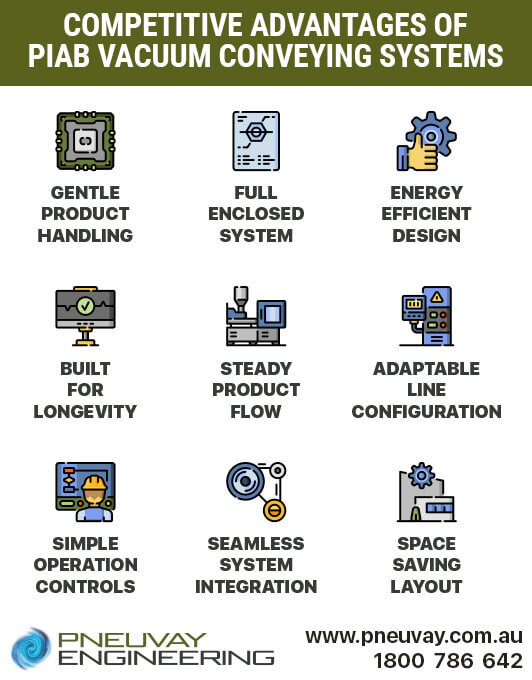
Competitive advantages of PIAB vacuum conveying systems
The piFLOW® range offers a comprehensive selection of vacuum conveyors specifically engineered to meet the diverse needs of several major industrial sectors. Every model in this product range provides an optimal technical solution for the specified material handling and processing requirements, including those considered most challenging.
Our engineers deploy these systems to ensure seamless integration into both new and existing production lines that benefit from pneumatic vacuum conveying and fit within their capacity boundaries. This versatile product range ensures your facility can achieve maximum throughput while maintaining the highest levels of product integrity.
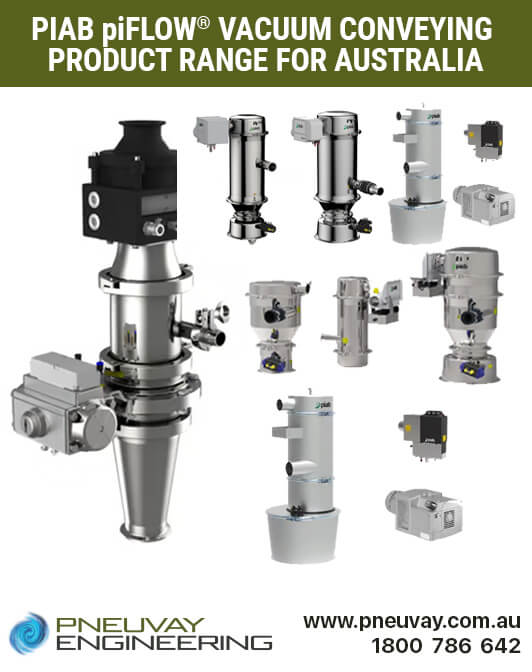
PIAB piFLOW® vacuum conveyor system product range for Australia
Premium vacuum conveyor engineered to meet the stringent sanitary requirements of the pharmaceutical and chemical processing industries.
Watch the video on the piFLOW®p pharmaceutical and chemical vacuum conveyor system for Australia
Unlike standard mechanical conveyors that suffer from material degradation and high maintenance, this system uses advanced vacuum technology to transport sensitive powders. These traditional systems often rely on open belts or buckets that expose materials to environmental contaminants and can lead to significant product loss. Furthermore, mechanical designs incorporate complex moving parts that require frequent lubrication and pose a constant risk of mechanical failure during operation. In contrast, this vacuum solution ensures a fully contained, dust-free environment that protects both the operator and product integrity.
This is built for delicate bulk solids in pharmaceutical environments to:
Technical specifications are as follows:
| Category | Specification | Value/Range |
|---|---|---|
| Construction | Material | ASTM 316L, EPDM, Q, NBR, ePTFE, PTFE, PE, PET, PA, Al, SS, PP |
| Weight | 11 to 102 kg | |
| Filter Area | 0.031 to 7 m² | |
| Performance | Vacuum Range | 60 to 75 kPa |
| Min. Particle Size | 0.5 or 5 μm | |
| Material Batch Volume | 2 to 56 L | |
| Efficiency | Feed Pressure | 0.4 to 0.7 MPa |
| Feed Pressure (Control) | 0.4 to 0.6 MPa | |
| Air Consumption | 2.5 to 112 Nl/s | |
| Noise Level | 69 to 77 dBA | |
| Environment | Temperature Range | 0 to 60 °C |
Specifically designed for demanding food and beverage environments where hygiene and precision are critical, this high-performance system surpasses the capabilities of standard conveyors to meet the stringent requirements of sensitive production lines.
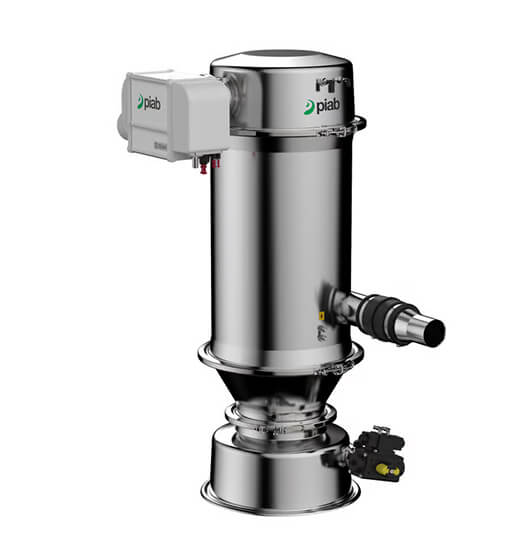
piFLOW®fc for heavy-duty industrial vacuum conveying for Australia
Manufacturers rely on this system for a level of quality and safety that mechanical equipment simply cannot match, including:
When you choose the piFLOW®fc, you replace outdated equipment with high-performance technology that meets your most rigorous industry standards.
The system utilises a high-performance discharge mechanism that ensures a controlled and consistent flow of material into your receiving vessel. This engineering design protects the integrity of your ingredients while maintaining a reliable seal throughout the vacuum conveying cycle. The electropolished ASTM 304 stainless steel body provides a hygienic environment and the durability required for demanding production schedules. An integrated filter system automatically cleans itself with each cycle to maintain peak performance and prevent significant pressure drops.
This is designed for industrial bulk solids in high-volume environments to:
Technical specifications are as follows:
| Category | Specification | Value |
|---|---|---|
| Construction | Material | ASTM 304, ASTM 316L, NBR, ePTFE, PET, PA, Al, SS, PP |
| Weight | 31 to 35 kg | |
| Filter Area | 0.06 to 1.5 m² | |
| Performance | Vacuum Range | 60 to 75 kPa |
| Material Batch Volume | 0.5 to 5 l | |
| Efficiency | Feed Pressure | 0.4 to 0.7 MPa |
| Air Consumption | 5-7 to 45-56 Nl/s | |
| Noise Level | 67 to 72 dBA | |
| Environment | Temperature Range | 0 to 60 °C |
A high-quality vacuum conveyor for food and chemical applications that do not require acid-resistant steel.
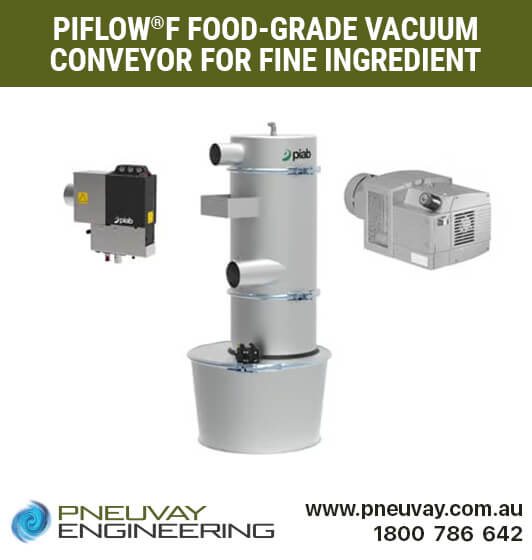
piFLOW®f food-grade vacuum conveyor for transferring fine ingredients in Australia
This food-grade system offers a fully enclosed, hygienic transport solution that eliminates the risk of external contamination during production. The modular discharge plate facilitates the safe and efficient release of food materials directly into mixers or automated packaging lines. Its dust-free operation protects the manufacturing environment while ensuring that operators are not exposed to airborne particles or hazardous food dust. The unit features food-grade materials that comply with global safety standards and fits easily into existing production areas within your facility.
This is for food ingredients in gravity flow or vacuum systems to:
Technical specifications are as follows:
| Category | Specification | Value/Range |
|---|---|---|
| Construction | Material | ASTM 304, EPDM, NBR, ePTFE, PTFE, PE, PET, PA, Al |
| Weight | 27 to 35 kg | |
| Filter Area | 0.09 to 0.5 m² | |
| Performance | Vacuum Range | 60 to 75 kPa |
| Material Batch Volume | 6, 8, 14, 28 l | |
| Efficiency | Feed Pressure | 0.4 to 0.7 MPa |
| Air Consumption | 5 to 37 Nl/s | |
| Noise Level | 69 to 77 dBA | |
| Environment | Temperature Range | 0 to 60 °C |
A versatile and robust unit for general industrial materials such as sand, talc and pellets.
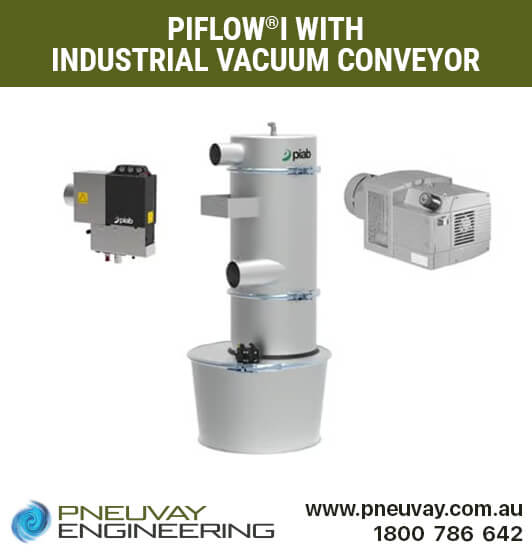
piFLOW®i general industrial vacuum conveyor for Australia
The industrial model features a heavy-duty discharge module that optimises the flow of abrasive bulk solids and manufacturing materials. This robust construction ensures long-term durability while providing a smooth bore that improves overall performance and reduces pressure drops during conveying. The system self-cleans the flap valve seat on each stroke, significantly improving the operational life of internal components. This focused design reinforces Pneuvay’s commitment to providing leading-edge vacuum solutions that meet the unique challenges of the Australian industrial sector.
This vacuum unit provides a contained and efficient transport method. Its robust construction ensures long-term durability while providing a smooth bore that improves overall performance and reduces pressure drop during conveying. The system self-cleans material from the valve seat on each stroke, which improves the operational life of internal components.
This is built to handle abrasive bulk solids in industrial environments to:
Technical specifications are as follows:
| Category | Specification | Value/Range |
|---|---|---|
| Construction | Material | ASTM 304, EPDM, NBR, ePTFE, PTFE, PE, PET, PA, Al |
| Weight | 27 to 35 kg | |
| Filter Area | 0.09 to 0.5 m² | |
| Performance | Vacuum Range | 60 to 75 kPa |
| Material Batch Volume | 6, 8, 14, or 28 l | |
| Efficiency | Feed Pressure | 0.4 to 0.7 MPa |
| Air Consumption | 5 to 37 Nl/s | |
| Noise Level | 69 to 77 dBA | |
| Environment | Temperature Range | 0 to 60 °C |
Engineered for the gentle transport of sensitive materials and ingredients such as tablets or capsules.
Watch the video on the piFLOW®t vacuum conveyor system for sensitive materials in Australia
The piGENTLE® technology provides a smooth, guided entry for materials, preventing sudden impacts or sharp direction changes. This gentle approach ensures that every tablet or capsule reaches its destination in perfect condition, maintaining the highest possible quality standards. By utilising a controlled and low-velocity flow, the system delivers superior handling for facilities managing the most delicate and sensitive materials.
This is for sensitive bulk solids without damage:
Technical specifications are as follows:
| Category | Specification | Value/Range |
|---|---|---|
| Construction | Material | ASTM 316L, EPDM, NBR, ePTFE, PTFE, PE, PET, PA, Al, SS, PP |
| Weight | Up to 50 kg | |
| Filter Area | Up to 0.25 m² | |
| Performance | Vacuum Range | 0 to -75 kPa |
| Min. Particle Size | 0.5 to 5 μm | |
| Material Batch Volume | 10 l | |
| Efficiency | Feed Pressure | 0.2 to 0.6 MPa |
| Air Consumption | 6 to 28 Nl/s | |
| Noise Level | 69 to 77 dBA | |
| Environment | Temperature Range | 0 to 60 °C |
Built specifically for the unique powder handling needs of the additive manufacturing and 3D printing sectors, this premium stainless steel (ASTM 316L) vacuum conveyor meets the requirements of highly demanding applications.
Watch the video on the piFLOW®am vacuum conveying system for additive manufacturing in Australia
This unit provides a contained and automated solution for metal powders by streamlining the reclaiming and feeding processes in a safe environment. Its minimal footprint allows for seamless integration into existing production lines without compromising performance. The integrated discharge seal remains resistant to pressure fluctuations, ensuring a secure and fully contained environment for handling fine industrial powders. Its compact footprint and TC-coupling allow for easy integration into existing 3D printers and intermediate hoppers without requiring significant floor space. Our engineering team specialises in configuring these systems to protect the purity of your metal powders while maintaining maximum operational efficiency.
Applications include:
This is for metal powders in additive manufacturing environments:
Technical specifications are as follows:
| Category | Specification | Value/Range |
|---|---|---|
| Construction | Material | Al, ASTM 316L, EPDM, NBR, PA, PTFE, SS |
| Weight | 13 to 15 kg | |
| Filter Area | 0.04 m² | |
| Performance | Vacuum Range | 41 to 56 kPa |
| Min. Particle Size | 0.5 μm | |
| Material Batch Volume | 0.5 l | |
| Efficiency | Feed Pressure | 0.4 to 0.7 MPa |
| Air Consumption | 6.6 to 8.7 Nl/s | |
| Noise Level | 69 to 73 dBA | |
| Environment | Temperature Range | 0 to 60 °C |
Find direct answers to the most common technical questions regarding PIAB material handling and system integration. These insights explain how this vacuum technology solves complex production challenges while maintaining maximum efficiency across your facility.
These vacuum conveyors can be easily configured to move materials in dense batches to keep lighter and heavier particles together throughout the transport process. This controlled method ensures your specific recipe remains perfectly mixed from the intake point to the final discharge valve.
When the superior vacuum pump is used, it requires a steady supply of compressed air at a pressure between four and six bar to create suction. This system uses an automatic valve to stop airflow during discharge cycles, helping to reduce energy consumption in your facility.
These conveyors feature a specialised ATEX-certified design that uses conductive stainless steel and grounding wires to prevent static electricity sparks. This built-in safety system ensures the unit remains fully compliant with strict industrial regulations for handling explosive chemical powders.
Your choice depends on whether you need a standard industrial unit, a food-grade system, or a premium pharmaceutical-grade conveyor. Our engineering team evaluates your material characteristics and hygiene requirements to help you select the most cost-effective and compliant model.
The modular design of these systems allows for easy mounting directly onto the inlet of your existing bagging or packaging equipment. This integration saves valuable floor space and creates a fully enclosed path that protects your finished products from external dust.
Our specialised engineering consultancy provides expert guidance and technical mastery to ensure your vacuum system achieves peak operational performance. Pneuvay prioritises a partnership-first approach rather than acting as a simple equipment reseller for your industrial material handling needs. We stock an extensive range of critical spare parts in Melbourne to provide rapid support and minimise your production delays.
Contact our technical team to receive a detailed quote and a professional assessment of your current factory layout requirements.
Schedule an appointment with our team for a technical consultation to discuss your specific requirements with our Melbourne office today. Feel free to call on 1300721458 or contact us. You can even send us a message via our Linked In page if you like.
Pneuvay Engineering has been granted PIAB distributor for Australia and now delivers vacuum conveying systems, offering high-performance solutions for bulk powders and materials.
Learn how this strategic development benefits our local industry.
Pipe and Tube Compression Couplings
Industrial Dust Collectors Systems
Dust Collectors Filters, Cartridges and Bags


