See our latest projects and be updated with recent news and features
happening in the world of pneumatic conveying, materials handling
and industrial vacuum systems.


Friday, September 18, 2026
Pneumatic conveying has evolved far beyond simply blowing powder through a pipeline. For heavy industries such as mining, cohesive or abrasive bulk solids can present significant material handling challenges. Hyperdense phase conveying uses low air speed and high-capacity bulk material transfer, making it an optimal solution for many applications.
Pneuvay Engineering has extensive expertise and experience in designing and installing these highly specialised systems. Our systems help industrial processing plants, including those across the Australian mining industry, move more tonnes of material with less energy, reduced wear and lower maintenance requirements.
Read on to understand what hyperdense phase conveying is and how it works. Discover when it is the optimal solution for material transfer in Australian heavy industry and mining.
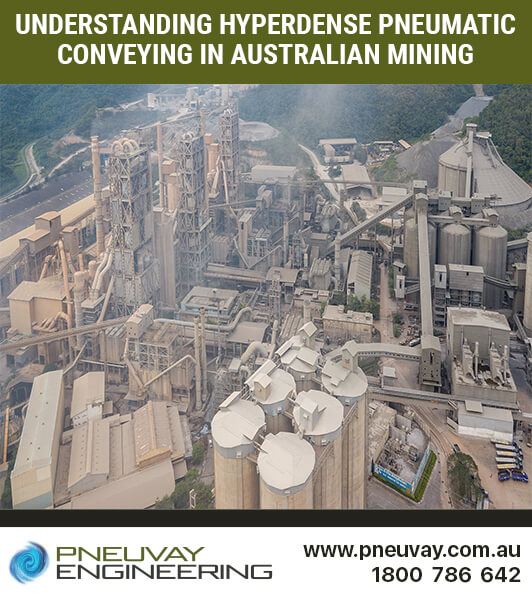
Understanding hyperdense phase conveying in Australian mining
Conventional pneumatic conveying systems are often limited by high air speeds that chew up pipes and damage fragile materials. Hyperdense phase conveying operates in an entirely different physical regime to solve this challenge and minimise operational costs.
The mass loading ratio compares the mass of material being transferred with the mass of air transporting it. This solids-to-air mass ratio within a pneumatic conveying system is a key metric. Conventional dense phase systems typically operate at mass loading ratios between 20:1 and 80:1. Hyperdense phase conveying systems push these material loadings well beyond 100:1, reaching 200:1 or more.
Rather than intermittent air pockets or discrete material slugs, the closed pipeline runs completely full of fluidised powder. This continuous column moves like a liquid through the pipe.
Material travels at ultra-low speeds, often down to 0.5 to 5.0 metres per second. This represents a massive reduction from the 18.0 to 35.0 metres per second speeds seen in standard dilute phase systems.
The system relies on specialised fluidisation membranes, continuous aerated gravity or low-pressure blow-pots to maintain a state of continuous fluidised movement through closed pipes.
| Phase | Velocity (m/s) | Solids-to-air mass ratio | Flow Profile | Material suitability (Geldart Group) | Typical application / risk |
|---|---|---|---|---|---|
| Dilute | 18 – 35 | < 15:1 | Suspended particles in high-speed air | All types (Group A, B, C, D) | Durable, non-abrasive bulk solids; high wear and attrition |
| Dense | 3 – 12 | 20:1 – 80:1 | Discrete plugs or moving dunes | Groups B & D (granular, pellets) + non-fluidisable A | Friable or moderately abrasive materials; pipe vibration |
| Hyperdense | 0.5 – 2.5 | > 100:1 – 200:1 | Continuous fluidised liquid-like column | Group A (fine, highly aeratable powders) | Smelting-grade alumina, fly ash, cement; low wear and degradation |
How does hyperdense phase conveying compare to dilute and dense
Applying hyperdense phase conveying principles requires a deep understanding of particle properties. The technology is highly suited to these specific sectors.
Fine cohesive materials like dry cement, fly ash, hydrated lime and silica powders tend to de-aerate and pack tightly, leading to severe pipeline blockages. Hyperdense phase conveying systems introduce continuous aeration to keep these challenging powders fluidised and free-flowing throughout the system.
Highly abrasive bulk materials like dry mineral sands, crushed limestone, tailings backfill and mineral concentrates cause severe pipeline wear from friction. Transporting these solids at near-zero speed protects the pipe walls from erosion and greatly extends the life of critical bends and fittings.
Smelter-grade alumina is highly friable and degrades rapidly when handled at high air speeds. Hyperdense phase conveying with its low air speed prevents particle breakdown while distributing alumina across potroom superstructures without segregation or dust generation.
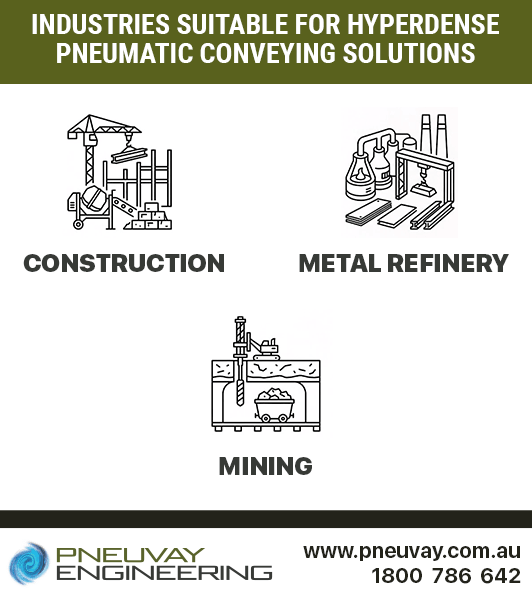
Industries suitable for hyperdense phase conveying systems
Not all bulk solids behave the same way inside a closed pipe. Hyperdense phase conveying relies on continuous, liquid-like fluidisation. When the material being transferred is a powder, it needs specific physical properties to achieve smooth and uninterrupted transfer. This checklist will assist in determining whether a given material may be suitable for hyperdense phase conveying.
| Assessment criteria | Ideal indicator | Why it matters |
|---|---|---|
| Particle size and classification | Fine, uniform powders (<100 µm, Geldart Group A) | Coarse grains or pellets (Geldart Groups B and D) release air almost instantly and will drop out into a hard slug |
| Air retention time | Retains trapped air for =15-30 seconds | A high air retention time allows the column to travel further between booster injection points without settling |
| Cohesiveness and moisture | Dry, free-flowing when aerated (<1-2% surface moisture) | Sticky, damp or hygroscopic powders clump together and resist uniform micro-fluidisation |
| Permeability | Low-to-moderate bed permeability | Low permeability prevents air from rushing straight through and escaping out the top of the bed |
| Primary project goal | Reducing severe pipe wear, degrading fragile product or cutting power costs | Hyperdense systems shine brightest when protecting pipes from abrasive powders (like alumina or fly ash) or protecting delicate crystal structures from shattering |
Materials suitable for hyperdense phase conveying.
Australia mining and heavy industry is one of the world's largest producers of raw bulk solids and refined minerals. Implementing low-speed hyperdense conveying solves several critical geographic and economic challenges across the Australian industrial landscape.
Standard high-speed dilute systems are highly abrasive because pipe wear is proportional to the cube of speed. This constant friction quickly destroys pipelines, leading to an expensive cycle of failures. By operating at a gentle speed of approximately 1 m/s, hyperdense conveying virtually eliminates pipeline erosion. It puts an end to constant pipe blowouts, structural damage and component degradation.
For remote Australian industrial and mining sites, this structural reliability represents a massive operational advantage. A single pipeline blowout initiates five highly disruptive and compounding site challenges.
A sudden pipeline blowout forces an immediate, unscheduled halt to the entire production line. This abrupt disruption halts material throughput and leaves expensive downstream processing equipment completely idle.
Accessing damaged, elevated pipeline sections or high-altitude bends requires sourcing specialised crane hires at short notice. Managing these complex logistics in remote areas introduces severe delays while safety permits and rigging crews are secured.
Repairing complex pneumatic piping systems requires certified tradespeople who are rarely stationed permanently on site. Plants must absorb the substantial expense of flying in external experts on emergency rosters and paying premium call-out rates.
Transporting custom heavy-wall spool pieces or wear-resistant elbows to remote regional areas requires expedited hot-shot courier services. These urgent freight surcharges add massive, unbudgeted logistics costs to the overall maintenance bill.
The financial impact of unscheduled downtime accumulates rapidly and often dwarfs the physical cost of replacement parts. Every hour the conveying line remains inactive represents lost throughput, missed deadlines and severe contractual delivery penalties.
In remote contexts, reducing pipeline wear and eliminating maintenance shutdowns provides far greater long-term economic value than simple power savings.
A common industry misconception is that dense phase conveying always uses less energy. While hyperdense systems operate at higher vessel pressures, they achieve superior efficiency by transporting significantly more material per unit of conveying gas. Operating the system in this fluidised state delivers three key utility and infrastructure benefits.
Moving dry powders in a continuous fluidised column dramatically reduces the total volume of compressed air required to transfer bulk tonnage.
Lowering the required volumetric flow rate directly decreases the electrical load on heavy plant compressor fleets.
Transporting bulk materials at near-zero speed in a completely sealed system delivers three distinct sustainability advantages.
Fragile materials like smelter-grade alumina fracture easily at high transport speeds, generating hazardous dust fines. Moving these materials as a continuous fluidised column at near-zero speed prevents particle attrition and preserves the original product quality.
Minimising particle breakdown to reduce toxic gas emissions and protect overall processing performance.
Replacing dusty mechanical conveying belts or high-speed pneumatic lines with a fully sealed, closed-pipe hyperdense design completely eliminates dust leaks and toxic toxic emissions across the plant.
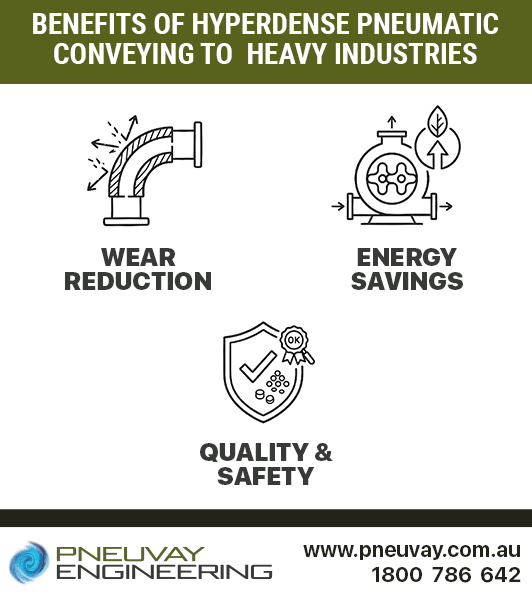
Benefits of hyperdense pneumatic conveying to heavy industries
Transporting alumina through a pipeline requires careful control to prevent product degradation. This is mainly due to these unique properties:
To understand how modern smelters overcome these degradation issues, it is helpful to compare the physical journey alumina particles take through pipe bends in standard lean phase versus advanced hyperdense phase conveying system as presented in this published research, Proceedings of the 9th International Alumina Quality Workshop by Hydro Aluminium researchers L. T. Kristiansen, A. K. Prytz and E. Tveten.
In high-speed dilute pneumatic conveying, alumina powder begins with aeration and dispersion, where high-pressure air suspends the particles into a fast-moving, dilute stream. As the flow approaches an elbow, a disconnect at the bend occurs because the lighter air corners smoothly while the heavier particles carry momentum forward. This trajectory mismatch triggers a direct wall collision, slamming the unyielding alumina into the outer pipe elbow at full speed. The impact causes immediate particle shattering, fracturing the crystalline grains into problematic fine dust and accelerating internal pipe wear.
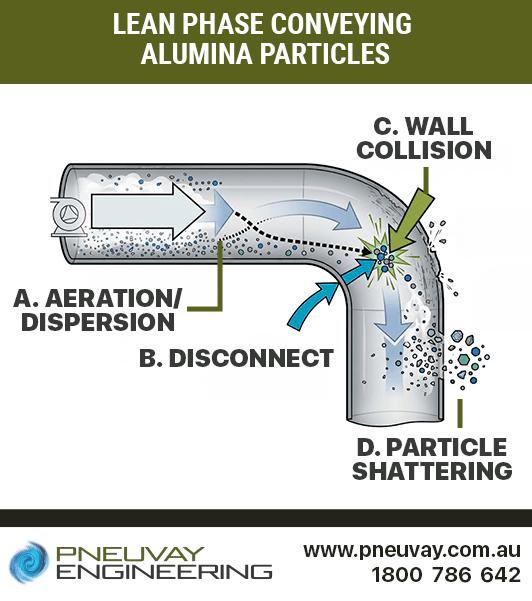
Conventional lean phase pneumatic conveying of alumina particles
In dense-phase pneumatic transport, alumina begins with high-density bed formation, filling the pipeline as a compact, slow-moving column under steady pressure. Upon reaching an elbow, the material executes a cohesive slug approach, where packed particles travel together rather than as free-flying projectiles. The mass then achieves gentle wall sliding, redirecting around the bend without sudden impacts. The turn concludes with mild inter-particle shear, where grains slip softly against one another to preserve particle integrity and prevent fine dust formation.
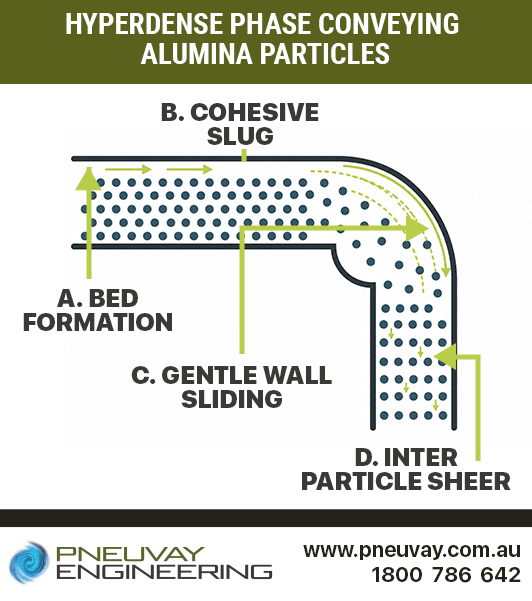
Hyperdense phase conveying of alumina particles
Selecting the right pneumatic conveying method depends on balancing air pressure, material speed and particle properties to optimise throughput and minimise system wear. The table below outlines the core differences in speed, flow profile and material handling capabilities across traditional dilute, standard dense and hyperdense phase systems.
| Feature | Dilute phase (Traditional) | Dense phase (Standard) | Hyperdense Phase (Specialised) |
|---|---|---|---|
| Speed | Very fast (15–35 m/s) | Moderate (3–8 m/s) | Extremely slow (0.05–0.5 m/s) |
| Material state | Suspended in high-speed air ( flying cloud) | Pushed as solid "slugs" or "plugs" separated by air pockets | Continuous, fully fluidised bed behaving like a liquid |
| Air volume and pressure | High volume, low pressure | Low volume, high pressure (compressed air) | Very low volume, low pressure (gentle aeration fans) |
| Action at pipe bends | High-speed projectile impacts into the outer pipe wall | Friction and shear as dense plugs scrape around the turn | Gentle, slow fluid flow without forceful impact |
| Primary breakage mode | Severe shatter, impact fracture | Inter-particle grinding / abrasion | Near-zero attrition and breakage |
Designing a high-capacity hyperdense conveying system requires extensive technical expertise to balance fluidisation pressures and prevent pipeline blockages. Standard pneumatic models are often too simplistic to account for complex particle behaviours under continuous pressure, making physical material testing and modelling essential.
If you have any questions in relation to pneumatic conveying systems or need help with minimising pipeline wear and particle attrition, feel free to call on 1300721458 or contact us. You can even send us a message via our Facebook page if you like.
Get social with us and see the latest news items from:
Pneuvay Engineering has been granted PIAB distributor for Australia and now delivers vacuum conveying systems, offering high-performance solutions for bulk powders and materials.
Learn how this strategic development benefits our local industry.
Pipe and Tube Compression Couplings
Industrial Dust Collectors Systems
Dust Collectors Filters, Cartridges and Bags


