See our latest projects and be updated with recent news and features
happening in the world of pneumatic conveying, materials handling
and industrial vacuum systems.


Friday, October 23, 2026
The wettability index dictates how particles interact with ambient humidity, pipeline walls and any injected liquids during pneumatic conveying. Injected liquids may be used for conditioning, lubrication, cooling or agglomeration of the conveyed particles to improve transport and control dust. The affinity for moisture by these particles is a critical, yet easily overlooked, factor in bulk materials handling systems.
Understanding this physical principle is vital for preventing system failures and ensuring long-term plant reliability across conveying lines, fluidised beds, dust scrubbers and injection systems.
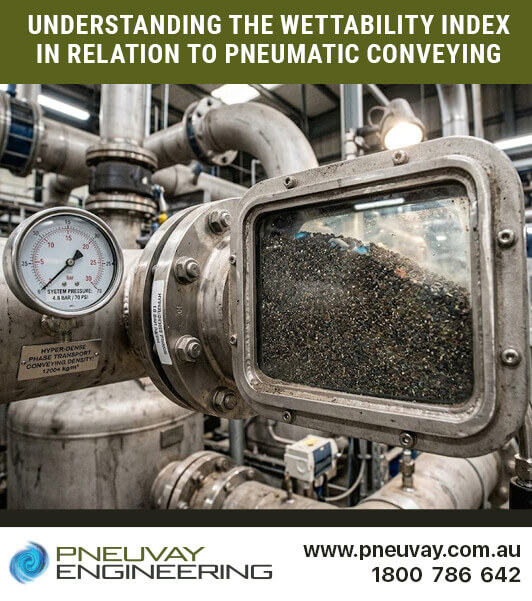
Understanding wettability when pneumatic conveying
Wetting represents the ability of a liquid to maintain contact with a solid surface through intermolecular forces. The wettability index, measured by contact angle, quantifies this liquid affinity. It determines how dry particles interact with ambient humidity, injected fluid sand pipe boundaries.
Consider how water beads up on a waxed car hood but spreads completely to soak into a paper towel. In pneumatic systems, this surface behavior drives several critical engineering outcomes.
Whether dry powder glides freely through your pipes or sticks to damp walls comes down to how much it likes water. If the powder grabs onto moisture inside the line, it quickly builds up along the edges. Controlling this stops buildup before it starts and keeps material moving without random slowdowns.
When water-friendly powders pick up tiny amounts of humidity from the air, they form an invisible moisture shield around each particle. This damp layer conducts electricity, naturally draining away the dangerous static charges that build up as particles rub against the pipes at high speeds.
Just like a dry sponge pulls up water from a surface, tiny pores inside powder particles can suck in ambient humidity. Even small changes in air moisture or added ingredients can cause particles to soak up water from the inside out, making them soft, sticky or prone to crumbling during storage and handling.
By accounting for these physical properties, engineers can better predict material behavior and optimise system performance. These foundational concepts are key to designing reliable, efficient and trouble-free pneumatic conveying solutions.
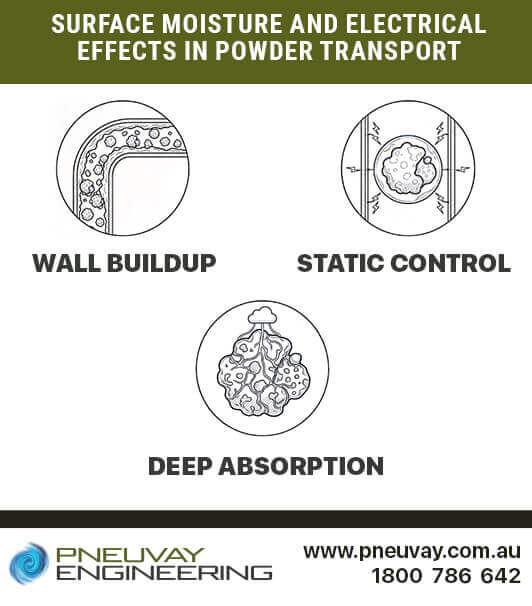
Surface moisture and electrical effects in powder transport
Applying conveying principles requires a deep understanding of particle properties. Bulk solids generally fall into three distinct categories when considering their affinity for water.
Hydrophilic materials like silica, cement, sugar and flour rapidly absorb ambient or compressed air moisture. This creates liquid bridges between particles, causing pipeline caking, hopper rat-holing and system blockages.
Hydrophobic materials like carbon black, coal dust and talc repel water. While they resist moisture caking, they cannot form a conductive water layer to dissipate static electricity, leading to heavy wall plating and elevated dust explosion risks.
Materials like pharmaceuticals, excipients and detergent powders generally have intermediate wetting behavior. These materials often feature engineered surface coatings and require tightly controlled conveying conditions to prevent surface hydration. Excipients are inactive ingredients added to a medicine to help with its manufacture, stability, appearance, handling or delivery, rather than providing the main therapeutic effect.
| Wettability | Examples | Key characteristics/risks |
|---|---|---|
| High (Hydrophilic) | Silica, fly ash, cement, sugar, salt, flour, starch | Rapid moisture absorption, liquid bridge formation, causes pipeline caking and system blockages |
| Intermediate | Pharmaceutical ingredients, excipients, metal powders, detergent powders | Variable wetting, often engineered with special coatings, requires controlled conditions to prevent surface hydration |
| Low (Hydrophobic) | Carbon black, coal dust, graphite, talc, plastic powders, sulfur | Repels water, resists caking, lacks conductive water layer, causes static electricity buildup and dust explosion risks |
How particle types classified by their wettability index
Instant and dissolvable powders are processed into loose and porous clusters (agglomerates) that allow rapid liquid wicking via capillary action. However, standard high-speed pneumatic conveying lines can easily degrade these fragile structures and ruin reconstitution quality. This physical degradation occurs through three primary mechanisms.
High speeds and hard impacts inside the pipes smash fluffy and porous powder clusters into tiny and flat dust particles. Instead of staying light and easy for liquid to grab, the powder becomes crushed and packed tight, making it much harder to dissolve later on.
H3: Slow soaking
When crushed powder hits water, the tiny particles pack closely together across the liquid surface instead of sinking in. This traps tiny pockets of air and locks water out, just like dry flour sitting on top of a bowl of water. Rather than dissolving smoothly, it forms stubborn clumps with dry powder trapped inside.
When powders with dairy fats shatter, the oil trapped deep inside leaks out onto the surface. This spreads a greasy and water-resistant film over each particle. As oil and water do not mix, the powder floats, refuses to blend and leaves an unappealing oily sheen on top of the liquid.
Understanding these mechanical degradation paths is the first step in protecting delicate powder structures. By identifying the root cause of particle damage, engineers can select appropriate conveyance methods to preserve original product quality.
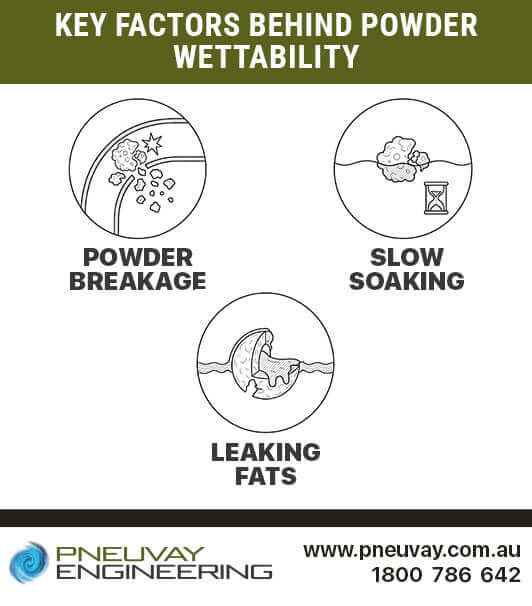
Key factors behind powder wettability in pneumatic conveying
Operating conditions significantly affect how much reconstitution quality degrades during pneumatic transit. System designers can preserve product integrity by focusing on these four key parameters.
Air speed is the primary driver of particle degradation. Increasing speed to 38 m/s can halve average particle size and destroy reconstitution performance.
High-speed dilute phase systems rely on turbulent air currents that easily fracture fragile and porous particles during pneumatic transit. In contrast, low-speed dense phase systems move materials gently in a slug or plug flow, which preserves the delicate particle structure and maintains the desired wettability index.
Increasing the concentration of solids relative to the amount of conveying air helps to cushion particles during pneumatic transit. This higher density significantly reduces the frequency and severity of direct impact forces against pipe walls, which helps prevent structural degradation.
Using long-radius pipe bends instead of tight 90-degree elbows drastically minimises frictional grinding at critical junctions. By smoothing out the path, these configurations maintain the integrity of the particle structure and prevent unnecessary fine generation.
Implementing these design strategies transforms the pneumatic system from a source of degradation into a protective environment for sensitive materials. Careful adherence to these parameters ensures that the material arrives at its destination with its original, high-quality wettability characteristics fully intact.
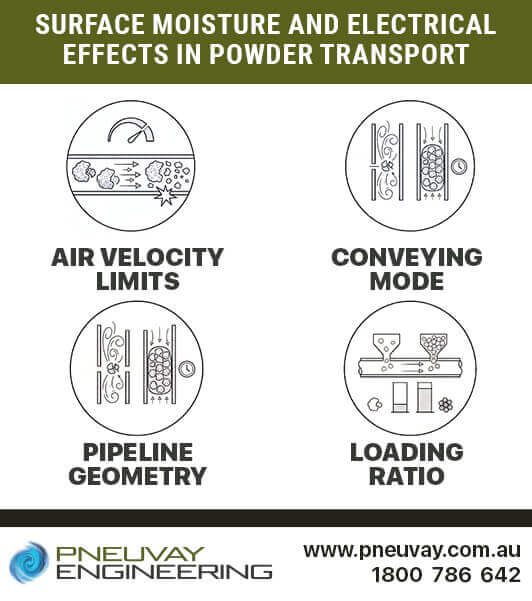
Operational factors in pneumatic conveying affected by wettability
Ignoring material wettability in pneumatic conveying system design can result in severe pipeline blockages and major safety hazards. Accounting for these physical limits allows engineers to implement effective safeguards. These extreme wetting behaviours present three major operational hazards.
When powders easily soak up humidity from the air, the individual particles stick to one another like wet sand. Instead of flowing smoothly, this clumped powder sticks to pipe bends, forms empty pockets inside storage bins that stop the material from dropping through and can clog your entire system.
Powders that resist moisture cannot easily bleed off friction. As they race through pipes at high speeds, they build up significant amounts of static electricity. This static acts like a magnet, pulling powder onto pipe walls to form hard crusts or melted plastic-like strings. Even worse, unchecked static sparks create a serious danger of sudden and unexpected dust explosions.
Standard wet dust collectors work by spraying water droplets to catch airborne particles. But water-repelling dust simply bounces off water droplets instead of getting trapped. This is much like trying to rinse grease off a frying pan using only cold water. Without specialised dry filters, this fine dust escapes right through the cleaning system and vents straight outside.
By identifying these specific material hazards, engineers can prioritise the necessary safeguards to protect plant integrity. Effectively managing these extreme wettability factors is essential for maintaining both operational continuity and workplace safety.
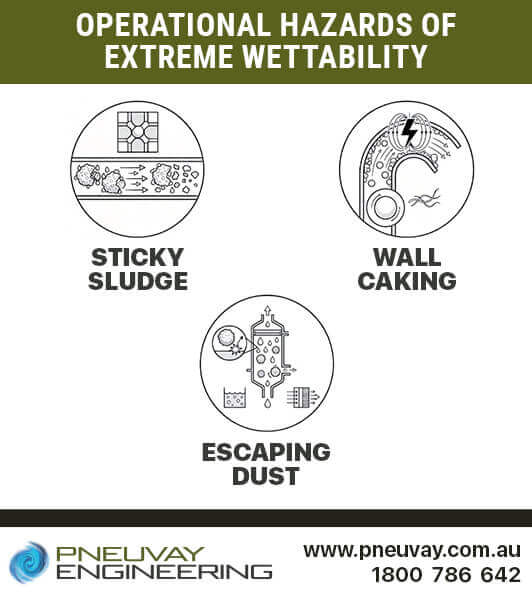
Operational hazards of extreme wettability
Pneuvay Engineering designs and installs custom systems to mitigate the risks associated with both hydrophilic and hydrophobic materials. Our engineering team integrates advanced equipment and controls to ensure reliable bulk material handling across Australia.
Plants handling cohesive or highly hydrophilic powders can transition to Dense Phase Pneumatic Conveying systems to prevent material caking and line blockages. Pairing these systems with AS1210-compliant Pressure Pots prevents material compaction under high pressure and ensures a highly stable and continuous flow
For fine dry bulk materials like cement and fly ash, gravity-assisted fluidisation using airslides avoids moisture caking issues. These systems utilise a continuous and low-pressure aerated bed that allows fine cohesive powders to behave like water and flow smoothly down gentle inclines.
Delicate food ingredients and pharmaceutical excipients require enclosed sanitary handling to prevent ambient moisture absorption and recipe segregation. Implementing fully enclosed PIAB Vacuum Conveying Systems allows plants to deploy the piFLOW®p pharmaceutical and chemicals model for active ingredients or the piFLOW®f food-grade model for transferring fine ingredients.
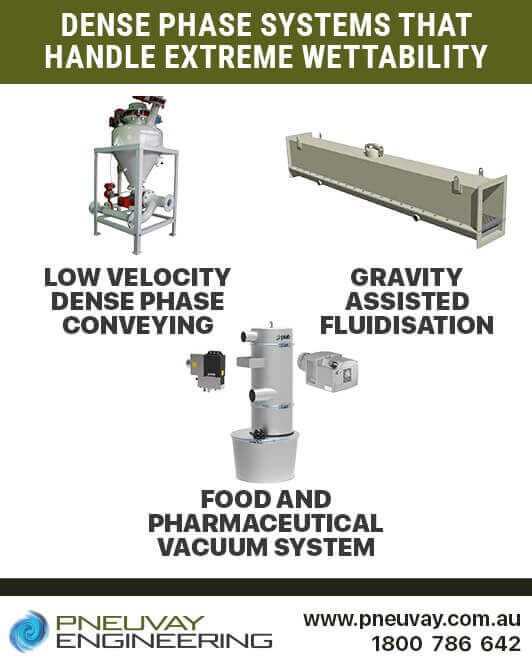
Dense phase systems that handle material with extreme wettability
Designing an optimal pneumatic conveying system requires a deep understanding of how materials interact with moisture and air pressure. Pneuvay Engineering conducts detailed material analyses and collaborates with research partners to model performance before installation.
If you have any questions in relation to pneumatic conveying systems and how your material will behave, feel free to call on 1300 721 458 or contact us. You can even send us a message via our Facebook page if you like
Get social with us and see the latest news items from:
Pneuvay Engineering has been granted PIAB distributor for Australia and now delivers vacuum conveying systems, offering high-performance solutions for bulk powders and materials.
Learn how this strategic development benefits our local industry.
Pipe and Tube Compression Couplings
Industrial Dust Collectors Systems
Dust Collectors Filters, Cartridges and Bags


