See our latest projects and be updated with recent news and features
happening in the world of pneumatic conveying, materials handling
and industrial vacuum systems.


Monday, November 23, 2026
Unplanned outages caused by blockages in large vacuum conveying systems can result in significant productivity losses for Australian industrial producers. This is particularly relevant to industrial hubs such as Altona and Kwinana. Maintaining consistent material flow throughout production is essential to achieving daily output targets. It also plays a critical role in ensuring overall plant profitability.
Our engineering team specialises in identifying and designing vacuum conveying systems that eliminate or minimise the risk of blockages. Our designs consider material characteristics and specific plant operating conditions to minimise production disruptions. The simple squeeze test forms the foundation of our proven system design process. We use its results to classify material behaviour and assess factors such as bridging. This enables us to identify potential flow issues and design systems that minimise the risk of blockages.
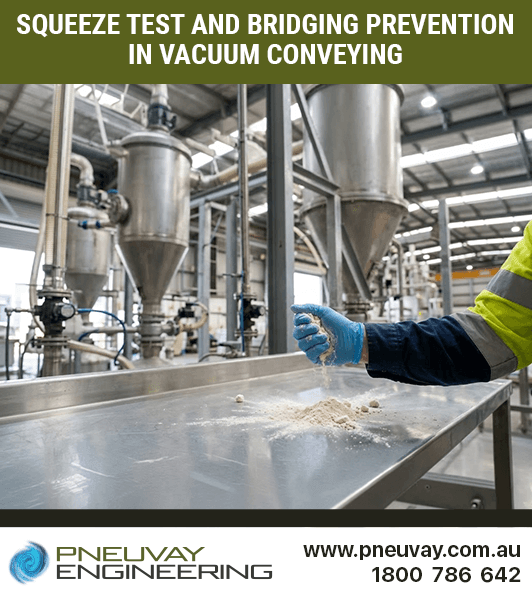
Squeeze test and bridging prevention in vacuum conveying
Bridging occurs when interlocking particles form a stable structural arch above the discharge outlet of a vacuum receiver or hopper. This phenomenon causes material to remain suspended, even when discharge valves are fully open to the processing line.
Bridge formation is often influenced by the physical characteristics of individual particles, including:
When subjected to vacuum conditions, particles can wedge together to create a self-supporting mass that resists gravity. This structural integrity can be reinforced by environmental factors, including ambient humidity and natural oils present in food ingredients. Identifying these physical triggers early in the design phase is critical. It helps determine the most suitable vacuum conveying system configuration for a given plant.
Understanding how these specific material traits affect flowability across different commercial applications helps determine the right system configuration.
Certain sectors and bulk solids are particularly vulnerable to material arching during vacuum conveyance due to their physical composition and handling requirements.
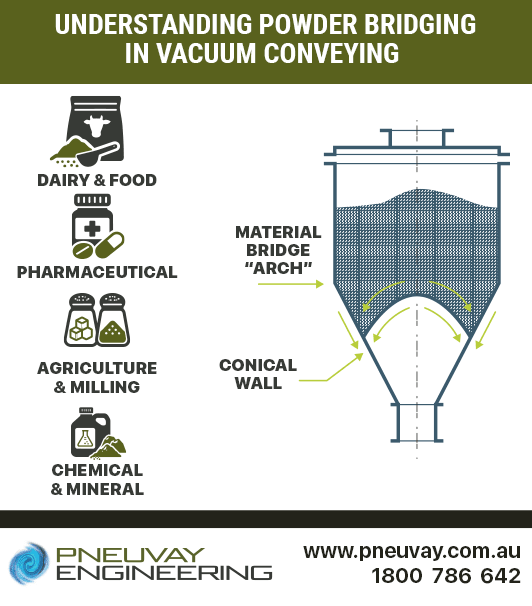
Understanding powder bridging in vacuum conveying
High-fat milk powders, whey derivatives and food-grade ingredients can be notoriously difficult to handle due to their high particle cohesion. These materials often clump under vacuum conditions, forming stable arches that can block discharge valves.
Our engineering team frequently recommends specialised fluidisers to help maintain consistent material flow. These devices help prevent sensitive powders from compacting and forming blockages. A best-practice vacuum conveying solution also maintains a consistent temperature throughout the conveying line. This helps prevent fat from softening and bonding particles together.
Titanium dioxide, fine mineral pigments and cohesive chemical powders often have high surface friction. This encourages mechanical interlocking during material transport. These powders can also adhere to internal receiver surfaces, causing rapid material build up.
Our engineering team uses specialised filter coatings and polished stainless steel housings to minimise material adhesion and reduce the risk of bridging. A best-practice vacuum conveying solution also requires careful selection of the discharge diameter. Choosing the correct diameter helps overcome the structural strength of abrasive mineral arches and promotes reliable material discharge.
Fine pharmaceutical and nutraceutical excipients often exhibit elastic properties that cause significant compaction under vacuum pressure. These materials can spring back inside the hopper, creating dense plugs that resist conventional gravity-fed discharge methods and include:
Our engineers specialise in designing vacuum conveying systems that are gentle and have controlled-velocity. These systems help protect the integrity of expensive and fragile ingredients. A best-practice solution would be a modular and compact vacuum conveying system that gently transports materials while supporting Good Manufacturing Practice (GMP) compliance such as the high-end piFLOW® vacuum conveying systems.
Hygroscopic materials, such as flour, sugar and finely ground grains are highly sensitive to changes in ambient factory humidity. Moisture absorption increases bonding between particles, significantly raising the risk of bridging within storage vessels. Controlling these environmental factors is essential for maintaining consistent, high-volume production in regional Australian milling facilities.
Our technical team provides expert guidance on managing atmospheric conditions when designing vacuum conveying systems. This is particularly important when handling moisture-sensitive agricultural products. Integrating air drying systems helps maintain optimal conveying conditions, ensuring consistent and reliable material transport.
The squeeze test is a simple yet effective rule-of-thumb assessment requiring only a handful of your product. This manual diagnostic tool helps our engineering team predict material behaviour before any system is designed. By firmly squeezing the material, you can observe key characteristics, including particle memory, moisture content and overall internal cohesion. These observations provide an essential baseline for determining whether a standard vacuum conveying system will perform reliably during production.
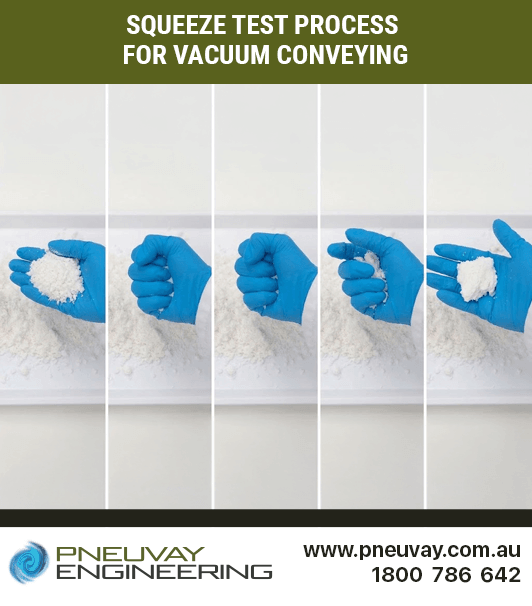
Manual squeeze test process in vacuum conveying
Executing and recording a squeeze test is simple. Start by putting on a protective rubber glove and grabbing a handful of the material. Then do the following:
This standardised approach ensures each diagnostic test provides reliable and repeatable data. The results allow our technical team to classify your product within a broader material flowability matrix and be used to support engineering decisions and system configuration.
Our engineering team uses these manual observations to identify potential risks, including pipe blockages and filter blinding. How a material retains its shape after squeezing indicates how it may behave under vacuum conveying conditions. Performing this diagnostic test during the design stage helps ensure your final system delivers reliable performance. It also minimises the risk of operational downtime.
If the sample demonstrates high cohesion, we may recommend integrating fluidisers or mechanical vibrators. These help maintain consistent material flow and reliable discharge and prevent structural bridging and ensure consistent material flow. Conversely, free-flowing materials that crumble easily often allow for a simpler, more cost-effective conveyor design. Standard hardware components may be sufficient for this type of material.
Industrial powders and granular materials behave differently under pressure. The flowability matrix provides a systematic way to classify these material behaviours. We use three categories to assess how materials interact with vacuum receivers and discharge valves. Matching squeeze test results to these profiles helps identify potential risks. These risks can then be addressed during the vacuum conveying system design process.
If the material crumbles immediately after releasing your grip, it is generally classified as a highly free-flowing industrial product. These materials typically consist of larger, uniform particles. They do not readily adhere to each other or internal conveyor surfaces.
The materials are at the lowest risk of bridging. It often allows standard discharge valves and filters to be used. Maintaining consistent conveying velocity is usually the primary consideration. This helps ensure reliable transport of stable and predictable bulk materials:
Category One materials include:
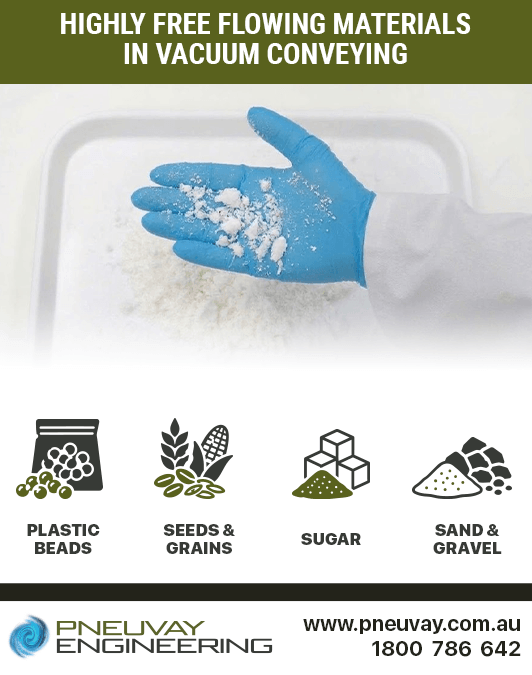
Highly free flowing materials in vacuum conveying
When a sample remains in a solid clump after squeezing, it indicates a cohesive material. These materials have a higher risk of bridging and filter blinding. Such materials often contain fine particles or elevated moisture levels. These characteristics cause particles to pack tightly under vacuum pressure.
Handling these Category Two materials requires specialised equipment, such as fluidisers or mechanical vibrators. These help ensure reliable material discharge from the receiver. We carefully select specialised filter coatings and larger discharge openings. These help prevent material build up on internal system surfaces.
Category Two materials include:
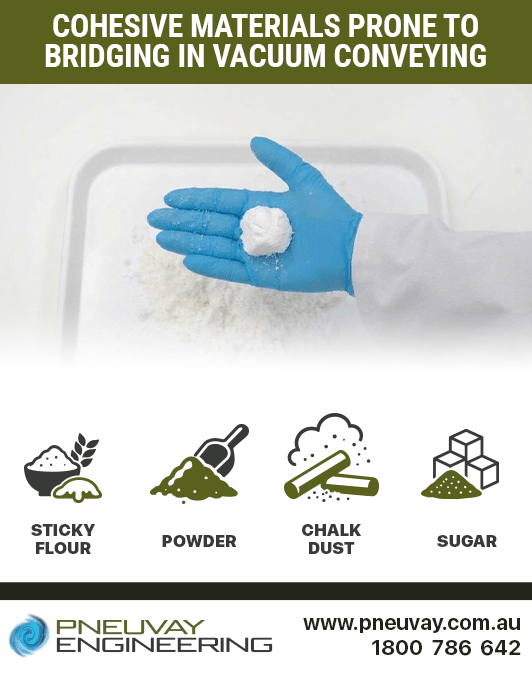
Cohesive materials prone to bridging in vacuum conveying
Material that springs back into its original shape indicates elastic properties. These characteristics may increase the risk of de-mixing or physical breakage. These are generally fragile and require gentler handling to prevent particle degradation during the conveying process.
Controlled velocity technology is essential for maintaining product integrity. It protects materials throughout the conveying process, from inlet to discharge. Our technical team evaluates these elastic properties to determine the optimal air-to-material ratio. This helps ensure safe and efficient material conveying.
Category Three materials include:
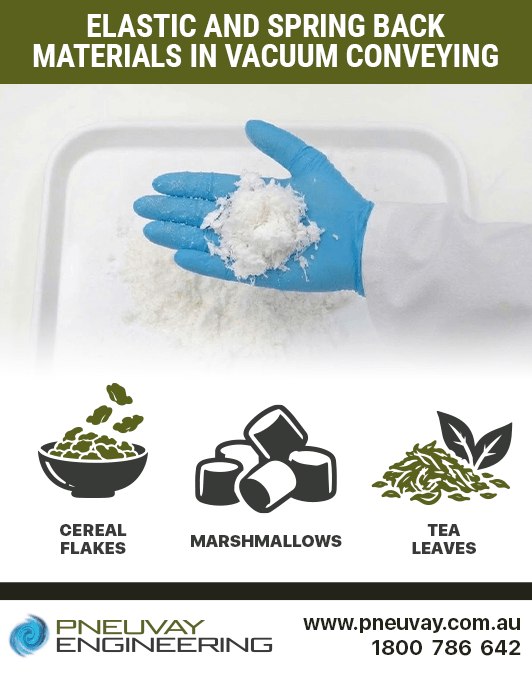
Elastic and spring back materials in vacuum conveying
Our engineering team provides expert guidance and consultations to help you optimise your specific material handling processes. We specialise in custom pneumatic solutions that integrate into existing lines to ensure maximum reliability and operational safety. Contact us today to request a professional consultation and see how our premium vacuum technology can elevate your operations. If you have any questions or need help, feel free to call on 1300721458 or contact us. You can even send us a message via our Facebook page if you like.
Get social with us and see the latest news items from:
Pneuvay Engineering has been granted PIAB distributor for Australia and now delivers vacuum conveying systems, offering high-performance solutions for bulk powders and materials.
Learn how this strategic development benefits our local industry.
Pipe and Tube Compression Couplings
Industrial Dust Collectors Systems
Dust Collectors Filters, Cartridges and Bags


